Who We Are
Collaborators
2025 Fellows
2025-2026 Artists in Residence
Join Us
Collaborations
Archipelago
Anthropocene Lab
Elements
Folger Institute
Futuring Lab
Natural Resource Conservation
Permaculture Design & Practice
Sustainable EweMass
UMass Beekeeping Club
UMass Natural History Collections
Wildlife Conservation
Research
Fellowships
Residencies
Rare Book Library
Living Laboratory
Courses
Lectures
Masterclasses
Conferences & Symposia
Sustainability Initiatives
Related Projects
Workshops
Grounded Knowledge
Exhibits
Art Exhibits
Rare Book Exhibits
Blogs
Renaissance of the Earth Blog
Life Underground
Calendar
Calendar

Renaissance of the Earth

Who We Are
Collaborators
2025 Fellows
2025-2026 Artists in Residence
Join Us
Collaborations
Archipelago
Anthropocene Lab
Elements
Folger Institute
Futuring Lab
Natural Resource Conservation
Permaculture Design & Practice
Sustainable EweMass
UMass Beekeeping Club
UMass Natural History Collections
Wildlife Conservation
Research
Fellowships
Residencies
Rare Book Library
Living Laboratory
Courses
Lectures
Masterclasses
Conferences & Symposia
Sustainability Initiatives
Related Projects
Workshops
Grounded Knowledge
Exhibits
Art Exhibits
Rare Book Exhibits
Blogs
Renaissance of the Earth Blog
Life Underground
Calendar
Calendar
 John Donne,  Devotions  (1624) Reading by candlelight was a common practice, but was not without risks.One reader held the book too close to the flame and set the text on fire.  On loan from the private collection of Joseph Black.

John Donne, Devotions (1624)
Reading by candlelight was a common practice, but was not without risks.One reader held the book too close to the flame and set the text on fire.
On loan from the private collection of Joseph Black.

 Thomas Burnet,  The Sacred Theory of the Earth  (1684) Just as he hypothesized that the earth was once covered in water, Burnet also asserted that the earth must endure a fiery conflagration that will allow it to return to its hollow, egg-like shape

Thomas Burnet, The Sacred Theory of the Earth (1684)
Just as he hypothesized that the earth was once covered in water, Burnet also asserted that the earth must endure a fiery conflagration that will allow it to return to its hollow, egg-like shape.
Held in the Kinney Center’s rare book collection.

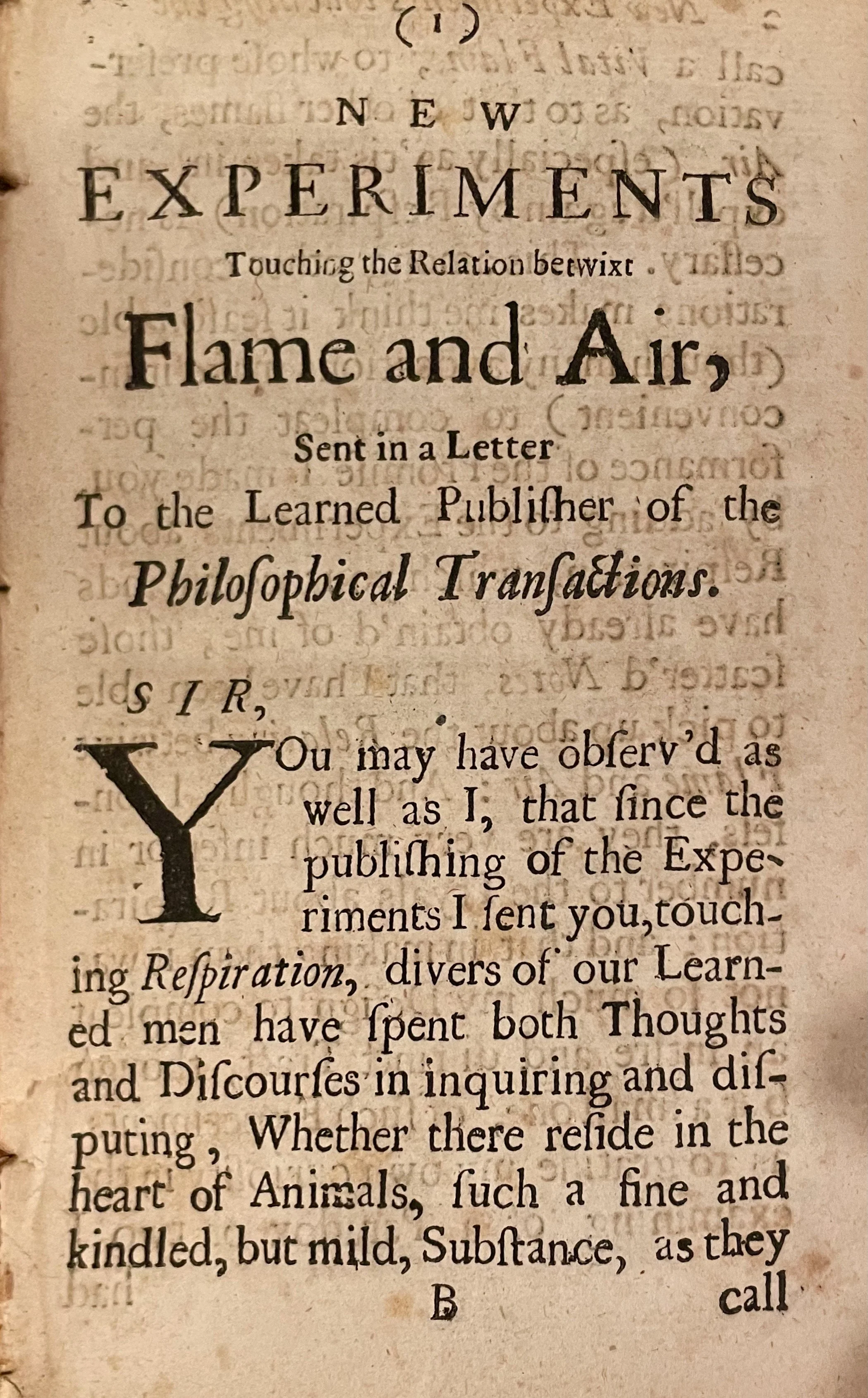
 Robert Boyle,  New Experiments, touching the relation betwixt flame and air  (1672) Boyle uses his air pump to better understand the relationship between these two elements, discovering, for example that fire needs air to burn. On loan from the Arch

Robert Boyle, New Experiments, touching the relation betwixt flame and air (1672)
Boyle uses his air pump to better understand the relationship between these two elements, discovering, for example that fire needs air to burn.
On loan from the Archives & Special Collections, Amherst College

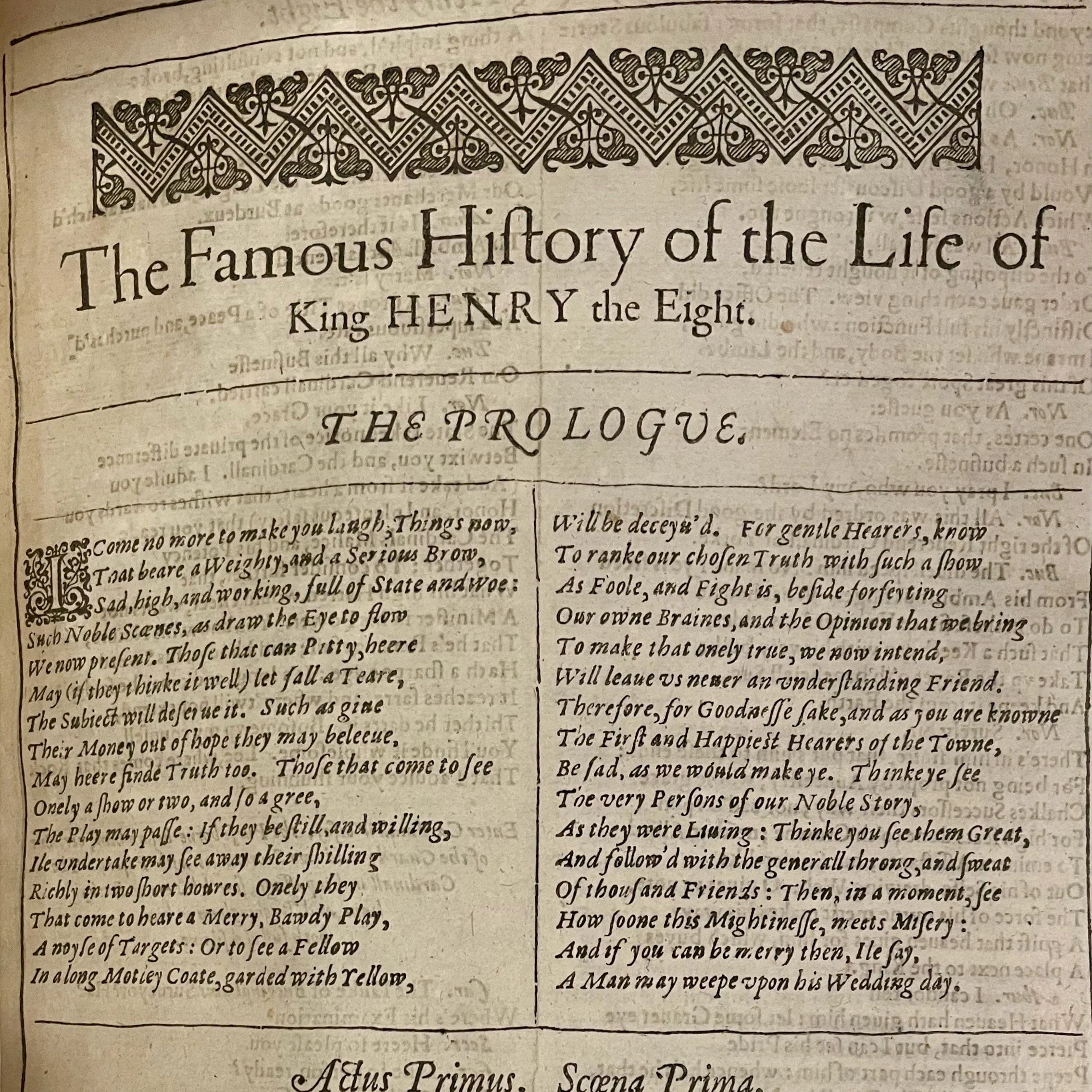
 William Shakespeare,  Henry VIII  (1623) It was during a performance of  Henry VII  in 1613 that the cannon fire called for in Act One set the thatch roof of the Globe on fire. On loan from the Gillespie Collection.

William Shakespeare, Henry VIII (1623)
It was during a performance of Henry VII in 1613 that the cannon fire called for in Act One set the thatch roof of the Globe on fire.
On loan from the Gillespie Collection.

 John Swan,  Speculum Mundi  (1635) This text, like Burnet’s Sacred Theory, attempts to reconcile scientific and religious understandings of the world. He explores the world’s beginnings, its impending demise, and its natural phenomenon—including the

John Swan, Speculum Mundi (1635)
This text, like Burnet’s Sacred Theory, attempts to reconcile scientific and religious understandings of the world. He explores the world’s beginnings, its impending demise, and its natural phenomenon—including the various fires in the skies such as comets, meteors, and firedrakes.
Held in the Kinney Center’s rare book collection.

1 2 3 4 5
Previous Next
 John Donne,  Devotions  (1624) Reading by candlelight was a common practice, but was not without risks.One reader held the book too close to the flame and set the text on fire.  On loan from the private collection of Joseph Black.
 Thomas Burnet,  The Sacred Theory of the Earth  (1684) Just as he hypothesized that the earth was once covered in water, Burnet also asserted that the earth must endure a fiery conflagration that will allow it to return to its hollow, egg-like shape
 Robert Boyle,  New Experiments, touching the relation betwixt flame and air  (1672) Boyle uses his air pump to better understand the relationship between these two elements, discovering, for example that fire needs air to burn. On loan from the Arch
 William Shakespeare,  Henry VIII  (1623) It was during a performance of  Henry VII  in 1613 that the cannon fire called for in Act One set the thatch roof of the Globe on fire. On loan from the Gillespie Collection.
 John Swan,  Speculum Mundi  (1635) This text, like Burnet’s Sacred Theory, attempts to reconcile scientific and religious understandings of the world. He explores the world’s beginnings, its impending demise, and its natural phenomenon—including the

The University of Massachusetts-Amherst occupies the traditional homelands of the Nolwottog or Nonotuck Nation. For actions beyond statements of recognition of Native lands, see MCNAA.

Back to Top

LOCATION

650 East Pleasant Street
Amherst, MA, 01002

HOURS

Monday - Friday
9:30 AM - 5:00 PM

CONTACT

Director — Marjorie Rubright mrubright@umass.edu